

Canon 5D Mark III Manual: A Comprehensive Guide
Discover a detailed resource for your Canon EOS 5D Mark III, encompassing setup, operation, and maintenance via a comprehensive PDF user manual.
Explore features, functionalities, and troubleshooting, alongside software installation guides found on the included EOS Software Instruction Manuals Disk.
Welcome to the world of the Canon EOS 5D Mark III, a professional-grade DSLR celebrated for its exceptional image quality and robust features. This camera, released on the 25th anniversary of the EOS system, represents a significant upgrade from its predecessor, the 5D Mark II.
This guide, based on the official PDF manual, will unlock the camera’s full potential, covering everything from initial setup to advanced customization. Prepare to master still and video capabilities with this comprehensive resource.
Understanding the Camera’s Physical Features
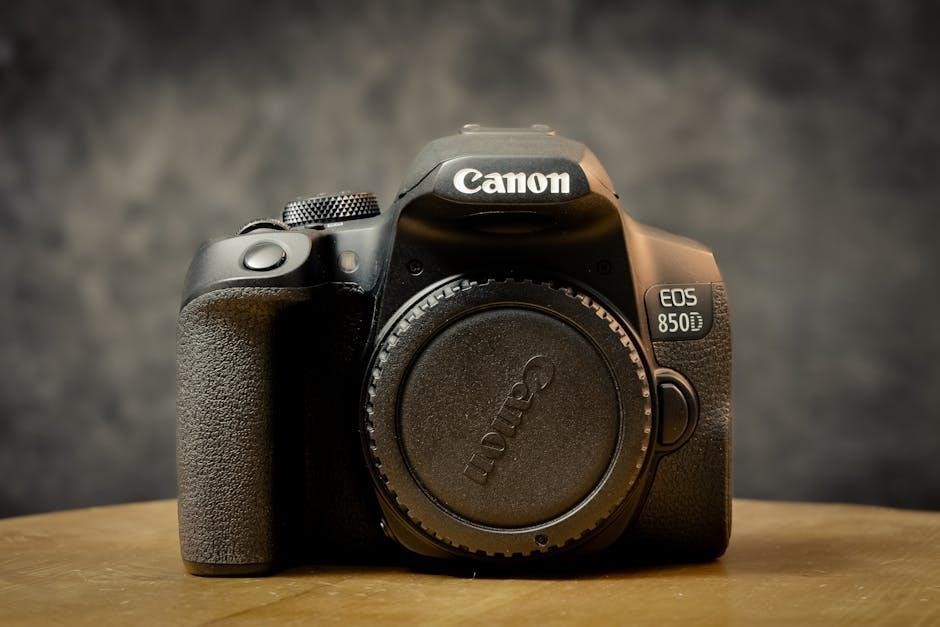
The Canon EOS 5D Mark III boasts a durable magnesium alloy body, slightly larger and heavier than the Mark II – measuring 152 x 116.4 x 76.4mm and weighing 950g. Familiarize yourself with its robust construction designed for professional use.
Refer to the manual (available as a PDF) to pinpoint the location of key buttons, dials, and ports, crucial for efficient operation and accessing the camera’s extensive functionalities. Explore the ergonomic design.
Body Construction and Ergonomics
The Canon 5D Mark III features a rugged body crafted from a magnesium alloy, ensuring durability and resilience in demanding shooting conditions; Consult the manual (PDF format) for detailed material specifications.
Its ergonomic design prioritizes comfortable handling, even during extended use. Discover how the grip, button placement, and overall balance contribute to a secure and intuitive shooting experience, as detailed in the user guide.
Key Buttons and Dials
The Canon 5D Mark III boasts a comprehensive array of buttons and dials for intuitive control. Refer to the manual (available as a PDF) to understand the function of each control, including the Main Dial, Quick Control Dial, and dedicated buttons.
Learn how to customize button assignments via Custom Functions, streamlining your workflow. Explore the menu system to unlock the full potential of these controls for personalized operation.
Setting Up Your Canon 5D Mark III
Initial setup is crucial for optimal performance. Consult the Canon 5D Mark III manual (PDF format) for detailed instructions on menu navigation and initial configurations. Ensure correct date, time, and copyright information settings are entered.
Familiarize yourself with the camera’s menu structure to personalize settings and unlock advanced features. Refer to the included software instruction manuals disk for further guidance.
Initial Camera Setup and Menu Navigation
Begin by powering on your Canon EOS 5D Mark III and following the on-screen prompts. Utilize the manual (available as a PDF) to understand each menu option. Navigate using the directional buttons and SET button for confirmation.
Explore the menu’s hierarchical structure, noting sections for shooting, autofocus, image quality, and customization. Refer to the software disk’s instructions for detailed explanations.
Date, Time, and Copyright Information Settings

Access these settings through the camera’s menu system, as detailed in the PDF manual. Accurately set the date and time for proper image metadata tagging. Input your copyright information to protect your work, embedding it directly into image files.
Consult the EOS Software Instruction Manuals disk for visual guidance. Ensure correct formatting to avoid errors; this information is crucial for professional image management and legal protection.
Mastering Shooting Modes
Unlock the Canon 5D Mark III’s full potential by understanding its shooting modes, thoroughly explained in the camera’s manual. Explore Aperture Priority (Av), Shutter Priority (Tv), Manual (M), and Program (P) modes.
Refer to the PDF manual for detailed explanations and practical examples. Utilize these modes to gain creative control over your images, adapting to various shooting scenarios as described in the EOS software instructions.
Aperture Priority (Av) Mode
Leverage Aperture Priority (Av) mode on your Canon 5D Mark III to precisely control depth of field, as detailed in the camera’s manual. Set the desired aperture (f-stop) and let the camera automatically determine shutter speed.
Consult the PDF manual for guidance on achieving creative effects like blurred backgrounds. Master this mode for portraits and landscapes, optimizing image quality based on the EOS system’s capabilities.
Shutter Priority (Tv) Mode
Utilize Shutter Priority (Tv) mode on your Canon 5D Mark III to freeze motion or create motion blur, as explained in the camera’s comprehensive manual. Select your desired shutter speed, and the camera will automatically adjust the aperture.
Refer to the PDF manual for optimal settings for sports or flowing water. Explore this mode to gain control over how movement is captured, enhancing your photographic storytelling.
Manual (M) Mode
Embrace full creative control with Manual (M) mode on your Canon 5D Mark III, detailed in the camera’s PDF manual. Independently set both aperture and shutter speed, allowing precise exposure adjustments for unique artistic visions.
Master this mode to overcome challenging lighting conditions and achieve specific effects. Consult the manual for guidance on balancing these settings for optimal image quality and creative expression.
Program (P) Mode
Utilize Program (P) mode on your Canon 5D Mark III for a balance between convenience and control, as explained in the comprehensive camera manual. The camera automatically selects aperture and shutter speed based on lighting conditions.
However, you retain the ability to adjust ISO, white balance, and exposure compensation. Refer to the PDF manual for detailed instructions on maximizing this versatile shooting mode.
Focusing System and Techniques
Master the Canon EOS 5D Mark III’s advanced focusing capabilities, detailed within the camera’s manual. Explore various autofocus modes – including One-Shot, AI Servo, and AI Focus – to suit different subjects and shooting scenarios.

Learn about selecting focus points and utilizing back-button focus for enhanced control. The PDF manual provides in-depth guidance on achieving sharp, accurate focus consistently.
Autofocus Modes and Selection
Dive into the Canon 5D Mark III’s autofocus system, as explained in the comprehensive manual. Understand the differences between One-Shot AF for static subjects, AI Servo AF for tracking moving subjects, and AI Focus AF which automatically switches between the two.
Explore focus point selection methods – automatic, spot, and manual – to precisely target your desired area. The PDF manual details customizing AF settings for optimal performance.
Manual Focus Operation
Master precise focusing with the Canon 5D Mark III’s manual focus capabilities, detailed within the camera’s PDF manual. Learn to utilize the viewfinder and LCD screen for critical focus confirmation.
Discover techniques for fine-tuning focus using the focus ring, and explore magnification options for enhanced accuracy. The manual explains how to switch seamlessly between autofocus and manual focus modes for creative control.
Understanding Exposure Control
Explore the core principles of exposure with your Canon 5D Mark III, as explained in the comprehensive manual. Learn how aperture, shutter speed, and ISO interact to determine image brightness.
Discover techniques for achieving proper exposure in various shooting scenarios, and understand the impact of each setting on image quality. The manual details exposure compensation methods for fine-tuning results.
Aperture, Shutter Speed, and ISO Relationship
The Canon 5D Mark III manual elucidates the interconnectedness of aperture, shutter speed, and ISO. Understand how aperture controls depth of field, shutter speed dictates motion blur, and ISO affects image sensitivity.
Learn to balance these settings for optimal exposure, considering their individual and combined effects on image noise and overall quality. Mastering this relationship is crucial for creative control.
Exposure Compensation Techniques
The Canon 5D Mark III manual details exposure compensation, allowing you to override the camera’s automatic metering. Utilize this feature when shooting scenes with challenging lighting, like bright snow or dark subjects.
Learn to adjust exposure values (+/- EV) to achieve desired brightness, preventing underexposure or overexposure. Practice using this technique for consistently well-exposed photographs.

Working with Metering Modes
The Canon 5D Mark III manual explains three primary metering modes: Evaluative, Partial, and Spot. Evaluative metering analyzes the entire scene for balanced exposure, ideal for general photography.

Partial metering focuses on a smaller area, while Spot metering measures light from a very precise point. Understanding these modes allows for precise exposure control in diverse shooting conditions.

Evaluative Metering
As detailed in the Canon 5D Mark III manual, Evaluative metering is the camera’s default mode, analyzing the entire image frame to determine optimal exposure. It considers brightness and contrast across the scene.
This mode is exceptionally versatile, performing well in various lighting situations, making it suitable for everyday photography. It prioritizes balanced exposure for most common scenarios.
Partial Metering
The Canon 5D Mark III manual explains Partial metering measures the average brightness of a 6.5% area in the center of the image. It’s useful when your primary subject is strongly backlit or has high contrast.
This mode allows for more precise exposure control than Evaluative metering, but requires careful composition to ensure the subject falls within the measured area. It’s ideal for challenging lighting.
Spot Metering
According to the Canon 5D Mark III manual, Spot metering precisely measures light from a very small 2.8% area in the center of the frame. It’s best for extremely high-contrast scenes where accurate exposure of a specific point is crucial.
This mode demands precise aiming and is often used with the AE Lock function to lock the exposure before recomposing the shot. It provides maximum control in difficult lighting situations.
Image Quality and File Formats
The Canon EOS 5D Mark III offers choices between RAW and JPEG file formats. RAW captures all image data for maximum editing flexibility, while JPEG provides smaller, compressed files ready for immediate use.
You can also select image size and compression levels, impacting file size and detail. Higher resolutions and lower compression retain more information, ideal for large prints or extensive editing.
RAW vs. JPEG Settings
Choosing between RAW and JPEG significantly impacts post-processing capabilities. RAW files contain unprocessed data, offering extensive editing control over white balance, exposure, and detail – essential for professional workflows.
JPEG files are compressed and processed in-camera, resulting in smaller file sizes but limited editing latitude. Select RAW for maximum quality and flexibility, or JPEG for convenience and immediate sharing.
Image Size and Compression Options
The Canon EOS 5D Mark III offers diverse image size and compression settings to balance quality and storage space. Larger sizes (e.g., 5760 x 3840) capture more detail, ideal for large prints or cropping.
Compression options include RAW, JPEG (Fine, Normal, Low), affecting file size. Higher compression reduces file size but may introduce artifacts. Choose settings based on intended use and storage capacity.
Video Recording Capabilities
The Canon EOS 5D Mark III excels in video, offering full HD recording at various frame rates – 24p, 30p, and 60p – for cinematic looks or smooth motion. Manual control over exposure and focus is available during recording.
External microphones can be connected for superior audio quality. Explore options for video resolution and frame rates to suit your creative vision and post-production workflow.
Video Resolution and Frame Rates
The Canon 5D Mark III supports full HD video recording at 1920 x 1080 pixels. Choose from standard frame rates including 24 frames per second (24p) for a cinematic appearance, 30p for general use, and 60p for smoother, faster-action footage.
These options allow for flexibility in post-production, enabling slow-motion effects or standard playback. Refer to the manual for detailed settings and considerations.
Audio Recording Options
The Canon 5D Mark III features a built-in microphone for basic audio capture during video recording. However, for superior sound quality, an external microphone can be connected via the 3.5mm microphone input.
Manual control over audio levels is crucial for optimal results. Adjust settings carefully to prevent clipping or excessively low volume. Consult the manual for detailed audio configuration.
Utilizing the Camera’s Menu System
The Canon 5D Mark III’s menu system offers extensive customization. Navigate through menus using the directional buttons and SET button, accessing features like Custom Functions and Picture Style settings.
Explore each menu tab to personalize your camera’s operation. Refer to the manual for detailed explanations of each setting, ensuring optimal control and tailored image creation.
Custom Function Settings
The Canon 5D Mark III allows personalized operation through Custom Function settings. Access these via the menu, assigning preferred controls to buttons and dials for quicker adjustments.
Customize up to six sets of functions, tailoring the camera to your shooting style. Consult the manual for a complete list and detailed explanations of each customizable option, maximizing efficiency.
Picture Style Settings
Canon’s Picture Style settings offer pre-defined image processing characteristics, influencing contrast, sharpness, and color tone. Options include Standard, Portrait, Landscape, Neutral, Faithful, and Monochrome.
Users can further refine these styles or create up to three custom Picture Styles. Refer to the manual for detailed adjustments of parameters like sharpness, contrast, and saturation, achieving desired looks.
Connectivity and Data Transfer
The Canon EOS 5D Mark III facilitates data transfer via a standard USB connection to your computer, enabling image download and camera control. Additionally, optional wireless file transfer is possible with a compatible adapter.
Consult the manual for detailed instructions on establishing a USB connection and utilizing wireless functionality. Explore software options for streamlined image management and editing post-transfer.
Connecting to a Computer via USB
To connect your Canon 5D Mark III to a computer using USB, ensure the camera is powered off, then connect the provided USB cable. Power on the camera and select ‘PC Connect’ from the menu.
Your computer should recognize the camera as a storage device, allowing you to transfer images. Refer to the manual for troubleshooting connection issues and optimal transfer settings.
Using Wireless File Transfer (with optional adapter)
To enable wireless file transfer, you’ll need a compatible Canon Wireless File Transmitter (WFT) adapter, sold separately. Install the adapter into the camera’s accessory shoe and follow the on-screen prompts.
Configure the WFT settings via the camera’s menu, connecting to a Wi-Fi network. Then, use a smartphone or computer to access and download images wirelessly – details are in the manual.
Troubleshooting Common Issues
Encountering problems? The manual details solutions for frequent error messages, guiding you through potential causes and fixes. Basic maintenance tips, like sensor cleaning and proper battery handling, are also included.
Refer to the troubleshooting section for issues with autofocus, image quality, or connectivity. Remember to consult Canon’s support resources for more complex problems or if issues persist.
Error Messages and Solutions
The manual provides a comprehensive list of error messages displayed on the Canon EOS 5D Mark III. Each message is accompanied by a detailed explanation of the potential cause and step-by-step solutions to resolve the issue.
Common errors related to the card, lens, or internal camera functions are addressed. Consult this section for quick fixes, preventing disruptions to your shooting workflow and ensuring optimal camera performance.
Basic Camera Maintenance
The manual emphasizes regular cleaning to maintain optimal performance. It details how to gently clean the sensor, lens, and viewfinder, avoiding harsh chemicals or abrasive materials.
Proper storage is also crucial; keep the camera in a dry, dust-free environment. The guide advises against prolonged exposure to extreme temperatures or humidity, ensuring longevity and reliable operation.
Accessing the Canon 5D Mark III Manual (PDF)
The complete Canon EOS 5D Mark III user manual is readily available as a PDF document. It’s often included on the EOS Software Instruction Manuals Disk that accompanies the camera.
Alternatively, you can easily download the PDF version directly from Canon’s official website or various online resources. This allows convenient access to detailed instructions and troubleshooting guides.
Software and Driver Installation
The EOS Software Instruction Manuals Disk, bundled with your Canon 5D Mark III, contains essential software and drivers for optimal camera functionality. This includes utilities for image viewing, editing, and transferring photos to your computer.
Carefully follow the on-screen instructions during installation. Ensure your computer meets the system requirements for seamless operation and access to all features.
EOS Software Instruction Manuals Disk Contents
The included disk provides PDF format instruction manuals detailing the EOS software’s operation. Users can find guides for image browsing, editing, and transferring data. Additionally, the disk contains drivers necessary for establishing a connection between your Canon 5D Mark III and your computer.
Refer to the disk’s contents for detailed guidance on utilizing all software features effectively.
Advanced Features and Customization
Unlock the full potential of your Canon 5D Mark III by creating custom shooting presets tailored to your photographic style. Explore the camera’s extensive menu system to personalize settings for optimal performance. Regular firmware updates are crucial, enhancing functionality and addressing potential issues.
Ensure your camera operates at its best with the latest updates.
Creating Custom Shooting Presets
Maximize efficiency by defining custom shooting presets for frequently used settings. Save combinations of aperture, shutter speed, ISO, and white balance for specific scenarios. Utilize the Canon 5D Mark III’s Custom Function settings to assign personalized controls.
Quickly recall these presets via the mode dial, streamlining your workflow and ensuring consistent results in diverse shooting conditions.
Firmware Updates and Their Importance
Regularly check Canon’s official website for firmware updates for your 5D Mark III. These updates often include bug fixes, performance enhancements, and new features. Installing the latest firmware ensures optimal camera operation and compatibility.
Follow Canon’s instructions carefully during the update process to avoid potential issues, safeguarding your camera’s functionality and longevity.

Resources and Support
Canon’s official website provides extensive support, including downloadable manuals, FAQs, and access to support forums for EOS 5D Mark III users. Numerous online tutorials and vibrant user communities offer valuable tips, troubleshooting advice, and shared experiences.
Leverage these resources to enhance your understanding and maximize your camera’s potential, connecting with fellow photographers for collaborative learning.
Canon’s Official Website and Support Forums
Visit Canon’s official website for the most reliable and up-to-date information regarding your EOS 5D Mark III. Download the complete PDF manual, firmware updates, and essential software.
Engage with the Canon support forums to connect with experts and fellow users, seeking solutions to common issues and sharing valuable insights about your camera.
Online Tutorials and User Communities
Enhance your Canon 5D Mark III expertise through a wealth of online tutorials, covering everything from basic operation to advanced techniques. Explore video guides and written articles created by experienced photographers.
Join vibrant user communities and forums to exchange knowledge, ask questions, and discover innovative ways to maximize your camera’s potential, benefiting from collective experience.